Posture and the Digestive System: Why does standing up straight relieve bloating?

At 2 PM after lunch, you sit at your desk and feel a churning of bloating or a dull ache from acid reflux. Your first thought might be, “Was that meal too greasy?” or you might reach into your drawer for digestive pills.
But before you blame the food, take a look at your posture: Are your shoulders drooping like a rubber band that has lost its elasticity? Is your spine bent into a “C” shape?
As an observer who has long studied the link between ergonomics and health, I have discovered a physiological truth that is often overlooked: your digestive problems may not be caused by what you eat, but by what you sit on. Today, we will step outside the musculoskeletal framework and delve into the little-known role of posture correctors in the field of visceral health—how they act as a “pressure relief valve” for your digestive system by altering the physical space.
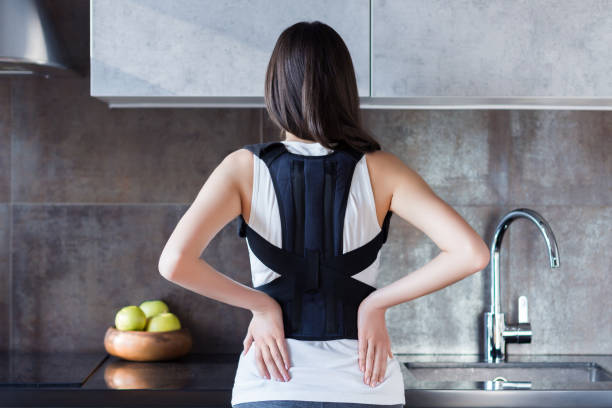
The squeezed “apartment”: How hunchback causes internal organ congestion
To understand how slouching causes indigestion, we can imagine your abdominal cavity as a small, well-furnished apartment. It houses numerous “tenants,” including the stomach, liver, small intestine, and large intestine.
When you stand upright, the apartment feels spacious, and each “tenant” does their job without disturbing the others. However, when you start to hunch over (kyphosis), especially when working at a desk for long periods, your ribcage collapses, and your ribs, like a collapsing ceiling, press down on your abdomen.
1. Mechanical compression of the stomach
This physical compression directly reduces the stomach’s expansion space. When your stomach tries to churn food through peristalsis, it finds itself surrounded by “walls.” This restriction not only slows down emptying (leading to a prolonged feeling of fullness after meals) but also increases pressure within the stomach.
2. Failure of the lower esophageal sphincter
This is the key to how Posture Corrector can indirectly relieve heartburn symptoms. There’s a gate between the stomach and esophagus called the lower esophageal sphincter (LES). When abdominal pressure increases sharply due to poor posture, this gate is forcibly opened, causing stomach acid to reflux. This is why many people experience significant acid reflux after napping in a relaxed, prone position.
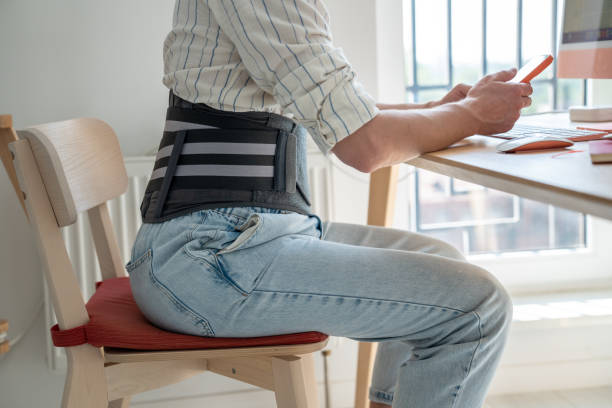
Abdominal pressure and spinal posture: Untying the “metabolic knot”
The relationship between abdominal pressure and spinal posture is central to this process. Digestion is not just a chemical reaction but also a physical movement (peristalsis).
The “massage” function of the diaphragm
Normal breathing and digestion depend on the up-and-down movement of the diaphragm. When you inhale, the diaphragm descends, gently massaging the internal organs below and promoting intestinal peristalsis.
Poor posture: Slouching and hunching can restrict the range of motion of the diaphragm, leading to shallow breathing. The internal organs lose this natural “massager,” intestinal peristalsis slows down, and waste gas cannot be expelled, resulting in bloating.
The “expansion” effect of the posture corrector
This is where the value of posture corrector intervention lies. It doesn’t just pull your shoulders back; more importantly, it forcibly opens the thoracic cage.
When you wear a posture corrector, it works through physical traction:
Lifting the ribs: Raising the slumped ribcage.
Stretching the abdominal wall lengthens the rectus abdominis muscle and reduces folding of the abdominal cavity.
This structural change is essentially “expanding” your internal organs. With more space, intra-abdominal pressure naturally decreases, blood circulation improves, and the secretion of digestive enzymes and intestinal peristalsis can return to their normal rhythm. This explains why simple strategies like improving posture to relieve bloating are often more direct and effective than medication.
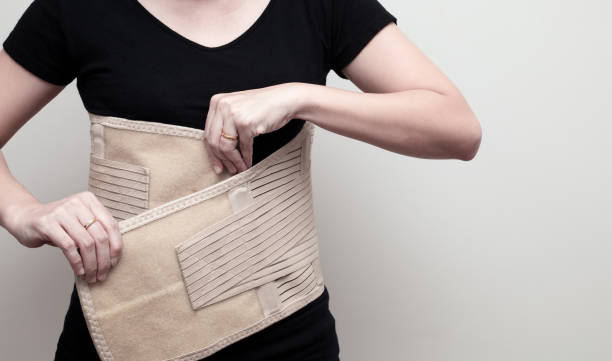
Practical Guide: How to Use Orthotics to Improve Your Post-Meal Experience
While posture correctors can effectively aid digestion, indiscriminate use can be counterproductive. As an industry expert, I recommend using it as a “post-meal aid.”
1. The golden 30 minutes after a meal
Avoid wearing a brace that is too tight while eating, as this can feel restrictive. The best time to wear it is after meals.
After your meal, put on the posture corrector and adjust the tightness to a comfortable level (you should feel the pull that opens your shoulders, but not so tight that it compresses your stomach). The corrector will then force you to keep your upper body upright, preventing you from slumping in your chair when you are most tired after eating.
2. Combine with “visceral breathing.”
While wearing a posture corrector, try deep abdominal breathing. Because the corrector restricts compensatory forward tilting of the chest, you will find it easier to feel the breath going deep into your abdomen.
Action: Inhale through your nose, feeling your stomach rise like a balloon; exhale through your mouth, feeling your navel retract towards your spine.
Effect: This type of breathing in the correct posture can maximize the activation of the parasympathetic nervous system (the “rest and digestion” system) and accelerate food metabolism.
Experts advise: Posture correctors are physical aids. If you suffer from severe gastrointestinal problems for a long time, please be sure to seek medical attention.
Conclusion: The Invisible Guardian of Internal Organ Health
We are used to pursuing square shoulders and swan necks for the sake of aesthetics, but visceral health posture management is the true value of posture correction that has been underestimated.
In this era where prolonged sitting leads to health problems, Posture Corrector is more than just a shaping bra; it’s more like an external skeletal support, providing a “living space” for your overburdened internal organs.
The next time you feel bloated and uncomfortable, try standing up, putting on your brace, and taking a few deep breaths. You’ll be surprised to find that when your body is upright, even the gas in your stomach will ease. Remember, a healthy digestive system first needs a comfortable, uncompressed physical environment.
FAQ (Frequently Asked Questions)
Q1: Will wearing a posture corrector immediately after a meal put pressure on my stomach?
It depends on how you adjust it. If the straps are too tight and compress the abdomen, it can indeed cause discomfort. The correct approach is to choose a posture corrector designed to avoid the abdominal area (such as a figure-eight strap) or to loosen the straps appropriately after meals. The goal is to use it to open up the chest, not to constrict the waist and abdomen.
Q2: Can a posture corrector cure gastroesophageal reflux disease (GERD)?
It cannot be cured directly. GERD is a complex pathological condition. However, using a posture corrector to improve long-term kyphosis can indeed reduce intra-abdominal pressure and decrease the frequency of stomach acid reflux due to physical compression. It is a very helpful adjunct but should not replace prescription medications.
Q3: Why do I feel like I’m hiccuping more after I started wearing braces?
This is a good sign! It usually means that the mechanism of improving posture to relieve bloating is working. When you move from a curled-up position to an upright position, the folds in the esophagus and stomach open up, and the gas that was previously trapped in the stomach finally finds a way to escape. This is exactly how the body releases stress.