Correcting “pseudo-correction”: Why is your posture corrector ineffective?

Have you ever had this experience: you buy a highly rated posture corrector with high expectations, vowing to correct your years-long hunchback? You wear it tightly every day like a bulletproof vest, persisting for months even when your armpits turn red.
However, the outcome is often frustrating: the moment you take it off, your shoulders slump back to their original position as if they’ve lost the support of gravity. Even worse, you start to feel lower back pain, and your spine, which could have stood up straight for a while before, now seems even weaker.
This is a typical example of “pseudo-correction.” As an industry expert who has long observed ergonomics and rehabilitation aids, I want to tell you a counterintuitive truth: if you feel “comfortable” and “effortless” wearing an orthosis, you are most likely using it incorrectly.
Today, we’ll unveil the mysteries behind these posture corrector-wearing mistakes and see why your device becomes a “crutch” that makes your muscles lazy, rather than a “coach” that helps you stand taller.
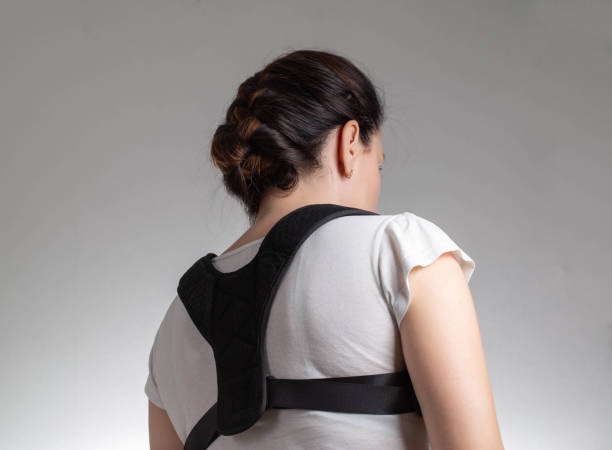
Myth 1: Treating it as an “exoskeleton” causes muscles to “go on strike.”
Many people buy posture correctors hoping for an external force to “forcibly” straighten their shoulders. This sounds logical, but it’s a fatal mistake from a physiological perspective.
It’s not true that the tighter the “tie,” the better.
If you wear your corrector so tight that you can maintain an upright posture without using any of your back muscles, then congratulations, you are experiencing a vicious cycle of muscle atrophy and correctors.
Passive support vs. active recruitment: When you hang your entire body weight on the corrective brace, the rhomboid, erector spinae, and deep neck flexors responsible for maintaining posture enter “vacation mode.” The brain receives the wrong signal: “Oh, there’s something supporting us here; we can relax.”
Consequences: Over time, already weak muscles will atrophy further due to disuse. This is why many people feel their backs are more tired and less supportive after removing their braces—their core muscles have weakened.
Remember, the true role of a posture corrector is a “reminder,” not a “replacement.” It should give you a gentle pull signal when your posture collapses, reminding you to straighten up yourself, rather than doing the work for you.

Myth 2: Incorrect mechanical adjustment and wearing position
Even if you understand the principle of “actively exerting force,” improper hardware debugging may still cause posture corrector side effects, such as nerve compression or incorrect postural compensation.
1. Axillary compression and nerve risks
This is the most common complaint: “numbness in the hands.” Many users, in pursuit of powerful shoulder opening, don’t know how to adjust the corrector straps and blindly tighten them. The armpit is an area with a high density of brachial plexus nerves and blood vessels; continuous high-intensity pressure can obstruct blood circulation and even cause irreversible nerve damage.
The correct adjustment standard is when you are in perfect, upright posture, the shoulder straps should be loose or only have very slight contact. Only when you begin to hunch your back should the shoulder straps tighten and provide resistance.
2. Position too high or too low
The posture corrector should be located between the scapulae (thoracic spine).
If it’s too low, the pull will be applied to the lumbar spine. To counteract the backward pull, your body will instinctively compensate through “anterior pelvic tilt” and “lumbar hyperextension.” As a result, instead of correcting the hunchback, you’ll develop a “fake perky butt” and lower back pain.
If it’s too high, it may compress the root of the cervical spine, exacerbating the forward head posture (text neck).
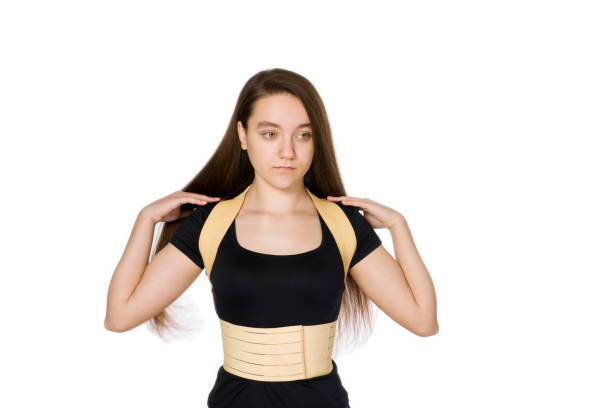
Scientific Application: The Correct Way to Activate Proprioception
Since we can’t rely on it, how should we use it? The key is to use the posture corrector to train your brain and muscles to establish connections, a technique known as “proprioceptive remapping.”
Three-step approach to “proactive fundraising”
Setting the baseline: Stand in front of a mirror, tuck your chin, open your chest, and assume your ideal posture. Then put on the equipment, adjusting the straps to fit snugly but not too tight.
Trigger mechanism: Start working. When you focus on the screen and unconsciously start to slouch, you will feel the straps tightening under your armpits or back.
Active Correction: This is the crucial moment! Don’t try to endure the tightness or try to relieve it by adjusting the straps. You should immediately contract your back muscles and actively pull your shoulders back until the straps relax again.
Through this cycle of “collapse-reminder-active correction,” you are actually performing hundreds or thousands of back muscle exercises.
Exit Mechanism: When Should You Discard Your Posture Corrector?
This might sound bad for businesses, but I have to be honest with you: Posture Corrector is a product you should strive to “no longer need.”
If used correctly, you should notice the following changes after a few months:
Unconscious correction: Even without wearing a brace, you will immediately notice that your shoulders are hunched forward, and you will automatically straighten them.
Shorter wearing time: You no longer need to wear it all day but only for 1-2 hours as an aid during the afternoon fatigue period.
Once you’ve established strong “muscle control” and proper posture awareness, you should gradually reduce the wearing time until you can get rid of it completely. Long-term reliance on any external device is not a healthy posture management approach.
in conclusion,
Posture Corrector is neither a scam nor a panacea. It’s a double-edged sword.
If used incorrectly, it can be a breeding ground for muscle atrophy and a torture device that creates nerve compression; if used correctly, it can be the most efficient personal trainer, monitoring and reminding you to activate your muscles around the clock.
Stop searching for that magical device that can straighten your body while you lie down. Real change happens the moment your brain decides to control your muscles. Adjust your brace, loosen it a little, and give your muscles room to work. Don’t let the brace bear your weight; let it teach you how to bear it.
FAQ (Frequently Asked Questions)
Q1: Is it normal to experience back pain when wearing a posture corrector?
It depends on the type of soreness. If it’s a slight muscle soreness (similar to the feeling after a workout), it means your back muscles are being “forced to work,” which is a good thing, indicating you’re actively engaging them. However, if it’s a tingling, joint pain, or a feeling of pressure in the spine, this is usually a sign of wearing the posture corrector incorrectly—it may be too tight or misaligned. Any sharp pain should be stopped immediately.
Q2: Since it can’t be worn all day, how long should it be worn each day?
To avoid the risks associated with muscle atrophy and correctors, a “fragmented wearing” strategy is recommended. Beginners can start with 2-3 times a day, 20-30 minutes each time. As muscle endurance improves, this can be extended to 45-60 minutes each time. Remember not to wear them while sleeping, and do not wear them continuously for more than 2-3 hours.
Q3: Can posture correctors cure scoliosis?
No. This is a very serious misconception. Commercially available soft posture correctors are only for poor posture caused by muscle imbalances (such as rounded shoulders and hunchback). Scoliosis is a three-dimensional skeletal deformity that requires professional rigid medical braces and intervention from a doctor. Attempting to “straighten” a curved spine with ordinary corrective braces is not only ineffective but may also worsen the condition.