Musicians and posture correctors protect their performing careers

Before the stage lights come on, the audience usually can’t see the subtle but recurring movements backstage: shoulders unconsciously raised, necks tilted to one side, backs gradually slumping after long rehearsals. Many musicians now use a posture corrector during practice or breaks to help maintain proper alignment. For violinists, guitarists, and even pianists, these movements aren’t “bad habits,” but instinctive compensations developed to complete the performance. The problem is that when the performance ends and the instrument is put down, the body doesn’t automatically return to a symmetrical and relaxed state. Over time, the musician’s body begins to “remember” these postures in an unbalanced way.
It is in these often-overlooked daily routines that occupational strain quietly occurs. More and more music professionals are beginning to discuss musician posture support, not just for stage performance, but also to extend their performing careers. Using a posture corrector can provide gentle reminders to maintain alignment and prevent long-term musculoskeletal issues.
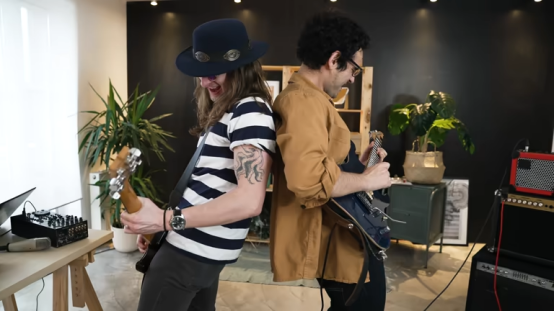
Why does asymmetrical playing become a long-term burden?
The playing of most musical instruments inherently exhibits a clear unilateral tendency. Take the violin as an example: the left shoulder is raised, the chin is fixed, and the right arm moves extensively, resulting in a continuous asymmetrical state of the upper body. Guitarists are similar; one shoulder rotates forward, and the torso twists slightly, seemingly stable, but in reality, it is a long-term imbalance. Some musicians use a posture corrector during practice sessions or breaks to provide subtle feedback and encourage a more balanced alignment.
In a short period of time, the body possesses an extremely strong ability to adapt. Muscles will redistribute their functions, and joints will find “effort-saving” pathways. However, the problem is that rehearsals are not a ten-minute affair. Data from music academies shows that professional or semi-professional performers typically practice for 3 to 6 hours daily, and over 70% of them do not receive systematic posture training or recovery guidance. This means that instrumentalist back pain is not an accident but a highly predictable outcome. Using a posture corrector can help musicians monitor posture during long practice sessions and reduce the risk of developing chronic musculoskeletal issues.
More subtly, pain is often not the first sign. Many musicians first feel that “the movements are not as smooth as before” or “certain musical patterns have become difficult,” which is actually a manifestation of decreased efficiency in the coordination between nerves and muscles. A posture corrector can serve as an early reminder to maintain proper alignment, even before discomfort or pain appears.
Aside from the performance, the posture issue didn’t end there.
A common misconception is that problems can be controlled simply by paying attention to posture while playing. However, the reality is quite the opposite. Extensive research and the experience of physical therapists indicate that what truly exacerbates strain is the “relaxation phase” after a performance.
After rehearsals, people often sit on the sofa looking at sheet music or scrolling through their phones, their bodies collapsing further due to the already weakened muscle tension. At this point, the brain considers the task complete and stops actively engaging the stabilizing muscle groups, resulting in the further reinforcement of incorrect posture. This is why many musicians still experience neck and shoulder discomfort even after reducing their practice volume.
In this context, the significance of a posture corrector lies not in “correcting playing posture,” but in providing the body with a continuous reminder of symmetry during non-playing hours. It is more like an environmental intervention than a forced correction.
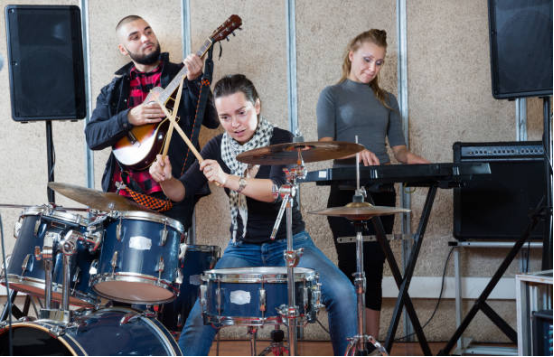
From “holding on with all your might” to “making your body remember symmetry”
effective but Traditional posture training often emphasizes strength, such as strengthening back muscles and stretching tense areas. These methods are effective but costly to implement, requiring time and professional guidance. In contrast, many musicians lack a low-barrier-to-entry daily maintenance method.
In practical feedback, many performers have mentioned that the posture corrector doesn’t “pull the body along,” but rather uses subtle changes in tension to make them aware of whether their shoulders are hunching forward again or their back is starting to sag. This passive reminder is perfect for use during short breaks such as reading sheet music, preparing lessons, or even commuting.
resistance but It’s important to note that the core of postural intervention is not resistance but rather the reconstruction of sensation. As the body gradually becomes familiar with symmetry, compensatory movements during performance will actually decrease. This is why some physical therapists recommend that musicians practice postural symmetry during non-performance hours, rather than forcibly adjusting during practice.
Symmetry training has a subtle influence on performance control.
Playing music with good posture may sound like a cliché, but from a neurocontrol perspective, it’s not as simple as just “sitting up straight.” Posture directly affects breathing patterns, core stability, and the controllable range of fine motor skills in the upper limbs. Using a posture corrector during practice can provide subtle feedback, helping musicians maintain the ideal alignment and maximize neuromuscular efficiency.
When the shoulder straps return to a relatively symmetrical position, the compensation required for finger movements decreases, and the burden on small muscle groups decreases accordingly. Some string players mentioned in interviews that when the back is no longer tense, fatigue after long periods of legato bowing is significantly reduced. This is not a placebo effect but a result of improved force transmission efficiency, which can be further reinforced with a posture corrector.
In this process, “posture” and “corrector” can be understood separately: the former is the target state, and the latter is the reminder mechanism. Their relationship is closer to “calibration” than “repair.” A posture corrector doesn’t force the body into position; it gently signals when adjustments are needed, helping the musician internalize better alignment over time.
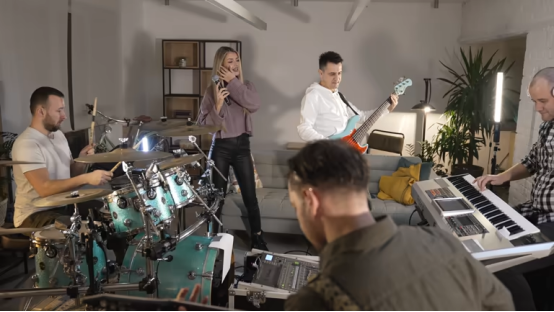
Overlooked details: everyday postures of musicians
Many articles discussing musicians’ postures focus only on the stage and rehearsal room, neglecting the details of real-life situations:
- Browsing and marking musical scores on a tablet
- Teaching while sitting in a chair of an unsuitable height
- Carrying the violin case on one shoulder during long commutes
The combined effects of these situations are no less significant to the body than a full rehearsal. For this reason, some performers have begun to incorporate posture correctors into these scenarios as a transitional tool, rather than a “solution” to wear all day.
This approach also aligns better with the current consensus on ergonomics: continuous awareness is more sustainable than short-term, high-intensity interventions.
Why are more and more musicians starting to discuss gesture tools?
Discussions about physical management have increased significantly in the music education and performance industries. The International Musicians’ Health Association has repeatedly emphasized that performance-related injuries have become a major cause of career interruption.
In online communities and forums, musician posture support has gradually shifted from a “side topic” to a core discussion point. Compared to ten years ago, today’s musicians are more willing to experiment with tools, training methods, and interdisciplinary approaches, rather than simply relying on endurance.
consumed but This doesn’t mean that posture tools are a panacea, but at least it represents a shift in attitude: the body is no longer a resource to be consumed but a partner that needs long-term maintenance.
How to integrate posture interventions into daily life rather than disrupt it?
A truly effective posture management solution must be sufficiently “low-profile.” If the intervention is too intrusive, it’s more likely to be abandoned. Many successful cases follow the same principle: avoid creating additional burdens during highly focused tasks.
Therefore, it’s actually easier to maintain a consistent posture when using the posture corrector for reading, lesson preparation, commuting, or light activities. It doesn’t affect the freedom of performance, but it silently calibrates the body’s condition backstage.
Find a more systematic breakdown and extension on the relevant posture support insights page.
Beyond music, the body also needs to be listened to.
Musicians are adept at listening to subtle changes in sound, yet they often overlook the signals their bodies send. Tension in the shoulders and fatigue in the back are not signs of a lack of willpower but rather the natural result of long-term, asymmetrical work.
Posture correctors cannot replace professional therapy, nor should they be mythologized. However, in professions that require long-term repetition of fine motor skills, they offer a realistic middle ground: providing continuous reminders without disrupting daily life.
Perhaps the real question worth considering is when the instrument is quiet, does your body finally have a chance to return to symmetry and balance?