Adjust the angle of the table and chairs, and use a posture corrector to free the spine

Do you often feel more tired sitting than standing? After long hours in front of the computer, your shoulders feel tight, your neck aches, and you feel like you’re being slowly “swallowed” by the chair back. This isn’t laziness; it’s because the height and angle of your desk and chair are subtly “betraying” your spine.
The spine doesn’t like being compressed, nor does it like losing support—it needs just the right amount of fine-tuning. When the angle of your desk and chair matches the natural curve of your body, and you use a posture corrector to guide your back muscles, you can regain true balance between “sitting” and “relaxing.”
Physical discomfort is actually sending signals
We all know that prolonged sitting is bad for your health, but have you ever truly experienced that feeling of leaden shoulders and a spine hunched forward all day?
Perhaps you’ve tried several chairs, bought a height-adjustable desk, and watched countless stretching videos, but by 4 PM, that feeling of discomfort still lingers.
The problem is often not that you sit for too long, but that you’re sitting at the wrong angle.
A screen that’s too low causes your neck to naturally tilt forward; a chair back that’s too straight forces your back muscles to support your weight; a keyboard that’s too high causes your shoulders to tense unconsciously.
These subtle deviations, like the butterfly effect, accumulate over time, slowly causing your body to deviate from its correct central axis.
When we readjust these angles, even by just a few centimeters, you’ll be surprised to find that your body’s burden is reduced, your breathing becomes smoother, and your focus returns.
This is the power of “fine-tuning.”
Desk height, screen angle, chair back support—each one has a key gap
Don’t think that these are things that only ergonomics experts know. In fact, as long as you master a few principles, you can completely “adjust a comfortable body angle” at home .
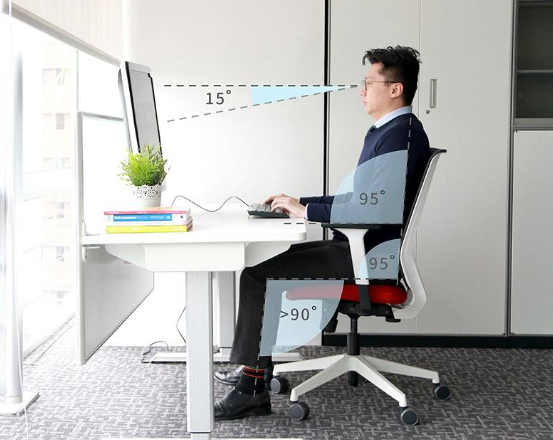
1. Screen height: Eye level with the top edge.
When you need to lower your head to look at the screen, your cervical spine begins to bear additional pressure.
Ideally, your line of sight should be right at the top edge of the screen , allowing your neck to be naturally straight.
If your laptop is too low, you can simply raise it with a book. It doesn’t have to be complicated.
2. Chair Back Angle: Straight Isn’t Always Good.
Many people assume you need to lean back perfectly straight, but that can actually lead to muscle fatigue.
The correct approach is to tilt the chair back slightly back 10-15 degrees , providing support without forcing your back .
Leaning naturally against the chair back can actually relax more muscle groups.
3. Seat Depth and Lumbar Cushion: Support your lower back, not your back.
If your lumbar spine has a slight S-curve, a soft cushion can reduce pressure on your lower back.
Choose a lumbar cushion that gently conforms to your lower back, rather than one that “hardens” it.
4. Desktop and Elbows: The 90° Rule.
When typing or using a mouse, keeping your elbows at a 90° angle and avoiding shrugging or shrugs in your shoulders can effectively relieve neck and shoulder stiffness.
5. Take a short break every hour.
Even something as simple as standing up and stretching, taking a few steps, or stretching your arms will earn your body’s gratitude.
Improving posture isn’t something that happens overnight; it’s a daily habit. However, using a posture corrector can gradually correct your bad habits.
The significance of assistive tools: when correction becomes a gentle reminder
We are used to “enduring it,” always thinking that the physical discomfort will go away on its own.
But the truth is – it will only get worse.
Sometimes, what we need is not forced training but a gentle reminder .
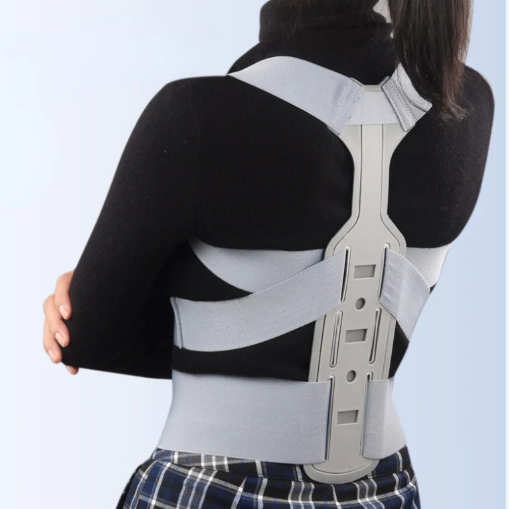
A lightweight, effective, undetectable – the posture corrector you’ll actually wear is like a portable coach.
It doesn’t constrict you uncomfortably but instead guides you back to the correct position without you even noticing .
When your shoulders begin to slump forward, it gently provides feedback, letting you know it’s time to relax.
And when your back straightens, it disappears silently, allowing your body to maintain its new balance.
Over time, your body’s memory will be reprogrammed: you no longer rely on it, but instead learn to actively straighten your chest and relax your shoulders. This is true correction.
Can posture correctors cause pain?
It won’t hurt, but it might be “a little bit uncomfortable to get used to”.
When your body has been in the wrong posture for a long time, the corrector allows the muscles to re-engage, and the initial soreness , tightness, and even slight discomfort are actually a signal that your body is “awakening.” It means that your muscle groups are being reactivated.
But if you feel persistent tingling or noticeable pressure , it’s usually because the wearing method or tightness is not appropriate.
The correct posture corrector should be lightweight, breathable , and fit the body lines without restricting your movements .
Therefore, pain does not equal effectiveness . Comfort, naturalness, and the ability to persist in wearing are the key.
Fine-tuning your body is actually recalibrating your life
You’ll find that once your body stretches out, even your mind becomes clearer.
That light, focused feeling isn’t the “lift” from coffee but the balance that comes from your body reconnecting with itself .
Maybe you can’t change your lifestyle overnight, but you can start today—raise your screen a little, relax your shoulders a little, adjust your chair back a little, and let a lightweight posture corrector quietly accompany you a little.
These seemingly small changes will unknowingly reshape your body language, work state, and even your confident posture.
Summary : It’s not just the body that’s straight, it’s also the rhythm of life
“Freedom” is never about indulgence but about the ability to find the right place for both body and mind.
When your spine breathes freely, when your body is no longer dragged down by fatigue, you’ll understand that a true posture corrector isn’t just about straightening your body; it’s about a conscious lifestyle.
Help your body build its own “posture memory” with a lightweight, effective, undetectable – the posture corrector you’ll actually wear .
Let us start from a small angle, from those few centimeters of adjustment, those few seconds of awareness, to regain our own body balance and daily freedom .