Breaking bad habits with science: Posture correctors intervene in muscle memory

Have you ever noticed a very strange phenomenon: when you first start using the posture corrector, your back is straight and you feel more energetic;
But once you take it off for a few hours, your body unconsciously collapses again, your shoulders move forward, and your neck leans forward, as if all your efforts are in vain.
In fact, it’s not that the product has failed, nor that you didn’t stick with it.
It’s that your body is “remembering” the past.
This is what’s called “muscle memory” —the body’s automatic memory system. It not only records your movement habits but also stores your posture patterns.
To truly change your posture, you must first understand its logic.
Your body is actually constantly “remembering” incorrect postures.
Have you ever noticed this:
You just reminded yourself to “sit up straight,” but within three minutes, your shoulders and waist slump again.
It’s like your body has its own “memory”; once you let your guard down, you automatically return to that “slouched posture.”
This is not a question of weak will, but muscle memory at work.
It allows the body to remember the most energy-saving and familiar way of movement – even if that posture is actually a “chronic torture” for the spine.
Posture correction is actually a process of “rewriting memory.”
Changing the body’s memory requires time, patience, and the right support.
Muscle memory: the body’s “autopilot system”
Muscle memory is a neuromuscular habit formed after your muscles repeat a movement.
Just like a pianist no longer needs to think about “which finger presses which key,” the body executes automatically.
Posture works similarly: when you live in a certain posture for a long time—such as looking down while typing or sitting with your chest hunched— your brain will default to: “Oh, this is the most effortless state for me.”
The problem is—saving effort ≠ correct.
Over time, neglected muscles (such as the latissimus dorsi and core muscles) will weaken, while compensatory muscles (such as the neck and small anterior shoulder muscles) will become increasingly tight.
The result is—rounded shoulders, forward head posture, hunchback… all appear.
This is why posture correction is not something that can be achieved overnight.
You’re not training your muscles, but rather retraining your nervous system to “re- understand” what correct posture is.
The Corrective Cycle: The Timeline of Body Renewal
From a physical science perspective, posture reshaping roughly goes through three stages:
1️⃣ Awareness Period (1-2 weeks)
The core of this stage is “awareness of mistakes.”
You begin to notice when your shoulders slump or your waist collapses.
This stage can be the most difficult, as each correction feels like “reversing fate.”
But it’s crucial—without awareness, there can be no change.
During this period , using a posture corrector can save you a lot of trouble.
Especially the cross-shaped design type—it allows your shoulders to open naturally outward and your back to tighten gently, not “binding you straight,” but “reminding you to straighten up.”
2️⃣ Remodeling period (3-6 weeks)
With continued training and correction, your muscles begin to reactivate. Your
core muscles take on more support, and your back gradually gains strength.
You’ll find that you can maintain a straight posture for minutes or even hours without the brace—this means new “postural memory” is being generated.
At this time, a posture corrector that can be worn all day can serve as a continuous reminder while you are working, walking, or even in a meeting. It does not replace your muscles, but helps you “prepare a draft” so that your body can relearn the sense of alignment.
3️⃣ Stabilization period (6 weeks or more)
At this stage, the connections between muscles and nerves stabilize.
Good posture gradually becomes an unconscious habit .
You’ll be surprised to find that straightening your back can be so natural.
It’s like learning to ride a bike—once you master it, your body won’t forget it.
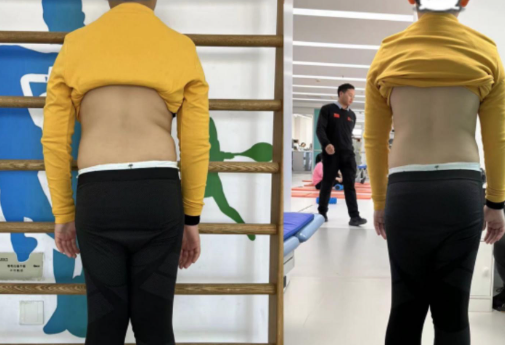
Does posture corrector really work?
Many people ask, “Are posture correctors really effective? Do they become useless once you take them off?#8221;
This is a great question because it dispels a misconception: posture correctors are not magic, but rather “assistive tools” for training.
Its effectiveness depends on whether you use it as part of your physical education routine .
If you rely on it only to “force yourself straight”—indeed, it will bounce back after you take it off.
But if you use it as a body reminder —helping you be aware of your posture, activate your core muscles, and correct the direction of your movements— then it is very effective.
In particular, modern all-day wear posture corrector – unisex crisscross design —distribute shoulder pressure while maintaining support, making them comfortable and comfortable for both men and women.
They make straightening a natural progression, not a painful correction.
Over time, it helps you train your body to actively remember the correct posture and that’s the real change.
Why “persistence” is the key
If you give up on the seventh day, your body will immediately revert to its old lazy routine.
After all, it’s been that way for years, even decades.
But when you continue training for four weeks or more, your brain begins to receive new signals:
“This position is more comfortable and more efficient.”
This is neuroplasticity at work.
That neural pathways change when an action is repeated more than 300 times .
So , you’re not training your muscles, but rather training your brain to “remember” the correct posture.
Orthotics, core training, and stretching exercises are all “catalysts” to help you establish this new neural pathway more quickly.

How to make the correction cycle more efficient?
To avoid missteps in posture correction, start with these small habits:
- Wear your brace intermittently, rather than tightening it all day.
This allows your body to actively participate in support, rather than relying solely on the brace.
② Combine light stretching and breathing exercises.
Five minutes of thoracic spine stretching combined with deep breathing daily can help your muscles “relearn” the correct midline.
③ Use a brace with a “crisscross” design.
This structure provides core support without restricting movement.
It’s suitable for long-term wear and can be invisible under clothing.
④ Pay attention to “feeling feedback.”
You shouldn’t feel tight or painful when wearing your brace. A slight sense of support is a good sign of correct support.
Reconstruction from body to mind
Changing your posture is actually a reconstruction of your inner temperament .
When you start to “straighten up,” you are not only straightening your shoulders, you are also correcting your state – from tired, flustered, and anxious to focused, confident, and relaxed.
Posture is the gentlest form of self-affirmation in body language.
It doesn’t speak loudly, yet it can make you stand out in a crowd.
In conclusion : Change begins the moment you stand up straight.
Muscle memory isn’t the enemy; it’s simply too accustomed to the old you.
Correction is a gentle re-education.
It won’t be immediately effective, but each small movement of straightening helps your body remember that ease and uprightness can coexist.
If you’re looking to regain your strength from prolonged sitting, consider getting yourself a all-day wear posture corrector – unisex crisscross design . It can naturally open your chest and re-align your center, allowing every time you stand up straight to become a new beginning of self-reconciliation.