Five-Minute Morning Posture Corrector: Posture Rebooting Method

The morning air carries a sense of undisturbed order. Most people wake up and immediately reach for their phones, their bodies still stiff from the night before. But in just five minutes, you can reawaken muscle memory, allowing your body to find natural support at the start of the day. Inspired by the same principles behind a posture corrector, this routine uses breathing awareness and gentle stretching to guide your body back into alignment. Through simple movements and conscious activation, you can turn this “posture reboot” into a sustainable daily habit.
Why is five minutes enough to reset your posture?
Many people believe that correcting posture requires extensive training, but the human body’s posture system is actually quite “intelligent.” Studies have shown that short, focused stretching sessions can significantly improve pressure distribution in the neck and spine. In other words, simply activating your core muscles during those golden five minutes in the morning can help you maintain a naturally upright posture throughout the day.
This isn’t magic but rather neuromuscular relearning. Muscles are often in a state of low tension after sleep, breathing rhythms are disordered, and the chest cavity isn’t fully expanded. Through posture corrector-assisted training or basic posture awareness exercises, you can restore flexibility to the thoracic spine, lengthen the lines of the neck and shoulder blades, and thus allow the body to rediscover its center.
A physical therapist noted in a research report that “just five minutes of postural activation each day can significantly reduce upper back pain and neck fatigue.” In other words, this process is not just “stretching,” but a ritualistic awakening of the body’s systems.

Breathing is the first step: calibrating the body with air.
Of all daily posture habits, breathing is the most easily overlooked core element. Incorrect breathing patterns can lead to tightness in the shoulders and neck, restricted chest expansion, and a gradually collapsing back.
Before you begin, find a natural sitting or standing posture, keeping your spine slightly extended. As you inhale deeply, focus your attention on your lower abdomen, not your chest—this helps the diaphragm descend, allowing oxygen to truly reach the deeper parts of your body. Exhale slowly, feeling your spine lift slightly. Repeat three times; you will feel a gentle force straightening your back.
The goal of this stage is to help the body rediscover the “midline.” You can incorporate gentle shoulder rotations or chest expansion, allowing airflow to become the command for postural adjustments. This approach differs from traditional posture correction exercises in that it focuses more on “perception” rather than “control.”
posture corrector at this time to help maintain the correct angle of their upper back. The key is not the device itself, but the reminder it gives you to “stay aware.” True correction always comes from the body’s coordination of breathing and muscles, not from external force fixing it.
Five-minute morning posture reset exercises
Step 1: Neck unlock (30 seconds)
Stand or sit comfortably. Slowly let your head drop into its natural curve, then rotate twice clockwise and twice counterclockwise. No need to force it—just allow gravity to guide the movement. This simple reset releases overnight stiffness and builds a foundation for posture alignment often supported by a posture corrector.
Step 2: Scapular awakening (60 seconds)
Extend both arms forward, palms facing each other, then gently open them outward as if closing your shoulder blades behind you. Inhale to expand your chest; exhale while maintaining the open position. This classic posture correction movement activates deep back muscles and helps reduce rounded shoulders—exactly the area a posture corrector typically assists.
Step 3: Thoracic extension (60 seconds)
Place your hands behind your head. Inhale as you lift your head and raise your chest; exhale to release. The motion doesn’t need to be dramatic. The key is restoring mobility in the thoracic spine. Steady breathing will gradually create a sense of openness in your chest, making this a strong complement to anyone who occasionally relies on a posture corrector.
Step 4: Core wake-up (90 seconds)
Move into a quadruped position and enter the Cat–Cow stretch. Inhale as you arch your back upward; exhale as you arch downward. This rhythmic movement realigns the spine and gently activates your core—one of the most important muscle groups for maintaining posture even without any posture corrector support.
Step 5: Breathing stillness (60 seconds)
Stand with your feet shoulder-width apart. Place your hands lightly on your lower abdomen, close your eyes, and take three deep breaths. With each breath, lengthen your spine and feel the subtle upward lift through your torso, reinforcing posture balance as you transition into your day.
Whether you use a posture corrector or prefer purely movement-based alignment, this five-minute sequence helps your body start the morning with clarity, length, and stability.
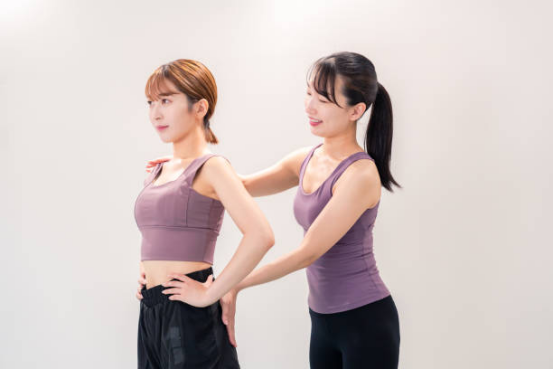
The psychological effects of posture training
Interestingly, regular posture training not only improves physical alignment but also profoundly influences mental state. According to a Harvard University psychology study, an upright posture can boost the secretion of testosterone and endorphins, subtly establishing a “positive control” emotional pattern. This is one reason many therapists pair posture exercises with tools like a posture corrector, which helps users maintain structural awareness long enough for these psychological benefits to take effect.
Maintaining daily posture habits is therefore not just about appearance—it becomes a form of “mindset adjustment.” When you spend five minutes each morning reconnecting with your body through breathing, stretching, and mindful awareness, even when assisted by a posture corrector during the early stages, your attention gradually shifts away from anxiety and procrastination and moves into a calmer pattern of self-regulation.
Some workplace wellness programs even integrate this short training ritual into their routines, noting that when posture is aligned—whether naturally or gently guided by a posture corrector—the brain’s focus and cognitive efficiency also rise.
Summary and Extension
The five minutes in the morning are not a time management trick but the starting point for body management.
From breathing to stretching, from awareness to posture correction, this morning posture routine not only helps you regain a natural, upright posture but also makes your energy flow more smoothly throughout the day.
When you realize that adjusting your posture is not just about changing your appearance but about “reprogramming” your body system, you will find it easier to stick to it.
If you would like to learn more about how to incorporate scientific posture corrector training into your daily life or explore posture assistance solutions suitable for the office, fitness, and travel, please visit our website to view more content on posture research and healthy habits.
After all, good morning posture often determines how you distribute your energy throughout the day. Your five minutes may just be the beginning of realigning your body and life.