How to properly wear a posture corrector to enhance its effectiveness

Many people experience a brief feeling of being “straightened out” when they first put on a posture corrector. Shoulders are pulled back, the back is straightened, and standing in front of the mirror, posture seems to improve immediately. But after a few days, the effect begins to fade: some feel uncomfortable, some doubt whether it “doesn’t work,” and some simply put it back in their drawer.
The problem often lies not in the tool itself, but in how it is worn and how it is used.
In the fields of ergonomics and rehabilitation training, a consensus is gradually becoming clear: posture support products are not simply “wearable,” but rather require proper understanding and use. Only when the way a posture corrector is worn synergistically with body structure, muscle memory, and daily routines can it truly realize its value. This article will start from design principles, breaking down the key steps of how to wear a posture corrector, common misconceptions, and sustainable usage methods to help you establish more scientific posture improvement habits.
Before wearing it, understand the working logic of the posture corrector.
If you simply understand a posture corrector as a “tool to straighten your body,” you’re almost guaranteed to use it incorrectly. In fact, it’s closer to a posture feedback system.
Most designs don’t forcibly fix the body but rather use shoulder straps, back support points, or elastic structures to create clear but controllable cues when posture shifts. The purpose of these cues is to activate the muscle groups that should be involved in support, such as the middle and lower trapezius, erector spinae, and core stabilizers, rather than replacing them.
This is why professional posture brace fitting guides repeatedly emphasize that you shouldn’t aim for “the tighter, the better.” Excessive tightness can put the body into a passive, dependent state, which actually weakens muscle engagement and may even cause new discomfort.
In the correct logic, a posture corrector is a “reminder,” not a “substitute.” Understanding this is the starting point for all wearing steps.

Complete breakdown of the correct wearing steps
The process of putting it on seems simple, but each step corresponds to different bodily responses.
The first step is to adjust your basic posture
before putting it on. Before putting it on, stand or sit naturally. Don’t deliberately puff out your chest or forcefully pull in your stomach; instead, keep your head, shoulders, and pelvis roughly in a vertical line. This “neutral position” is crucial, as it determines whether subsequent support is established on the correct reference point.
The second step is to start from the shoulders, not the back.
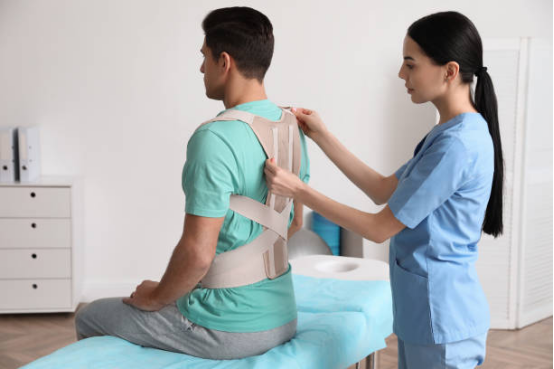
Many posture correctors are designed to form a closed loop starting from the shoulder straps. When wearing them, first place the shoulder straps naturally along the acromion, rather than rushing to tighten the back connection area. The shoulders are the most sensitive area to posture changes, and improper placement will directly affect the user experience.
The third step is to gradually adjust the tension
. A practical criterion for judging when adjusting the tension is that you should be able to clearly feel the tension, but it should not affect your breathing or arm movements. If you feel a significant restriction in your chest cavity when taking a deep breath, or if your shoulders feel pulled when you raise your arms, it means the tension has exceeded the reasonable range.
The fourth step is to dynamically test
standing, sitting, raising arms, and turning. Truly proper posture support should remain stable during movement, not just “look correct” when stationary. Frequent shifting during activity often indicates that the support needs fine-tuning.
These steps are not complicated, but they are the parts that many users skip.
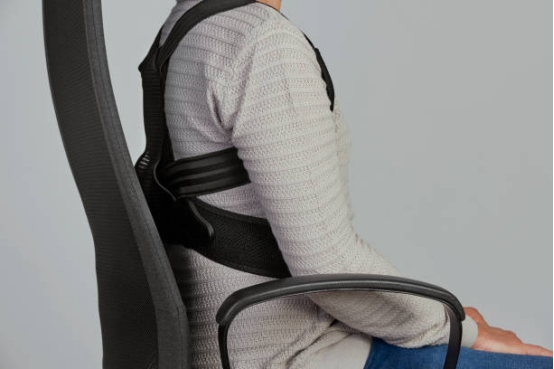
Common mistakes are more alarming than incorrect postures themselves.
In user feedback, poor performance is often not due to product ineffectiveness but rather to some highly repetitive incorrect usage.
The most common problem is “over-reliance.” Many people choose to wear them for extended periods from the start, hoping to see changes quickly. However, the result is that the body gradually relinquishes the support function to the external device, and once it is removed, the posture rebounds more noticeably.
Another typical mistake is “using it in the wrong context.” Posture correctors are not suitable for all activities. For example, they can amplify discomfort or even interfere with natural movement patterns during high-intensity exercise, long driving sessions, or situations requiring significant torso rotation.
Another hidden but far-reaching problem is ignoring the body’s feedback. Slight pulling, pressure, and skin friction are actually the body’s way of reminding you that your clothing needs adjustment. If you simply endure it, it often leads to localized fatigue or psychological resistance.
These errors are not uncommon, but they are enough to negate any positive effects that should have been produced.
From a design perspective, why wearing it correctly can accelerate posture improvement
From a structural perspective, most posture correctors concentrate the stress on the scapular region and upper back. These are precisely the areas where modern people are most prone to losing control.
When worn correctly, the shoulder blades are guided back to a more neutral position. This reopens the ribcage, making breathing easier and activating the back muscles more readily. This change is not drastic, but it is highly sustainable.
Some observations in the field of rehabilitation indicate that when worn correctly and combined with daily posture awareness training, users’ “self-awareness” of their body posture is significantly improved. This means that even without wearing the device, the body is more likely to return to the correct alignment.
This is precisely why how to wear a posture corrector is repeatedly emphasized: the way it is worn determines whether it is “reminding the body” or “controlling the body.”
Establish scientific usage habits rather than pursuing immediate changes.
The truly effective way to use something is often more restrained.
Many professional recommendations favor a short, frequent usage rhythm. For example, wear it during periods of prolonged sitting at an office, reading, or using a computer, and remove it during activity, walking, or exercise. This rhythm helps the body repeatedly compare the differences between “correct posture” and “incorrect posture” in different states.
At the same time, focus your attention back on your body. Do your shoulders naturally relax? Is your breathing smooth? Does your head unconsciously lean forward? These sensations are more important than the duration of wear.
Posture is not something that is created by what you wear.
Posture correctors themselves illustrate a fact: modern lifestyles are constantly challenging the original structural design of the human body. Screen time, prolonged sitting, and looking down will not disappear overnight.
Wearing a posture corrector correctly isn’t about “instantly looking better,” but about re-establishing the dialogue between your body and posture in the small moments of daily life. When the reminders become clear and the use becomes rational, true change in posture will begin.
Perhaps next time, when you’re about to put it on, you can pause for a second and ask yourself a question: This time, will you let it control your body, or will you let your body relearn how to stand properly?