Support and relaxation go hand in hand: The secret of the “elastic design” of posture correctors

Have you ever had this experience? When you first put on a posture corrector, you feel like your whole body is being “squeezed,” and your shoulders start to ache after a few minutes; but some people say, “A good posture corrector won’t make you uncomfortable at all; it will help you relax and straighten up.”
Sounds contradictory, right? — How can support and relaxation coexist?
Actually, this is precisely the secret of the posture corrector’s “flexible design.”
It doesn’t make you “rigidly” stand still, but rather, through flexible support and intelligent feedback, it helps the body re-establish a natural posture, making straightening up an easy instinct.
From “binding” to “support”: evolution of posture correctors
Previous correction belts acted like “forced correction,” relying on strong restraint to keep the body in the correct posture.
While they could straighten the back in the short term, they also had many side effects, such as pressure, stuffiness, restricted blood circulation, and even muscle dependency. The current design concept has shifted from “restraint” to “guidance.”
Modern correction belts emphasize the combination of ergonomics and elastic materials, using a multi-section stretch structure to “remind” the body to maintain the correct posture, rather than “forcing” it to do so.
The core of this transformation is elastic support .
The secret of elastic design: scientific logic of softness and strength
Many people think that the “flexibility” of posture correctors is just for comfort, but in fact, there is a whole set of scientific principles behind it.
1. Elastic band partition support structure
A good brace typically features different elastic zones, such as those for the back, waist, and abdomen.
This provides greater tension where support is needed (such as the shoulders and lumbar spine), while leaving room for stretch in areas of high mobility.
The result : the body is gently supported rather than rigidly pulled.
2.Material memory and rebound properties
Materials like polymer elastic fibers, spandex, and nylon blends are able to quickly rebound after being stretched.
This “memory elasticity” helps the body develop muscle memory , meaning that even after removing the brace, your posture will gradually become naturally straighter.
3. Mesh breathability and dynamic fit
The latest generation of products also incorporates a breathable mesh design , which maintains support while avoiding stuffiness and sweating.
Especially for those correction belts designed for people who sit for long periods of time, PU elastic fabric is used to achieve the perfect coexistence of support and breathability.
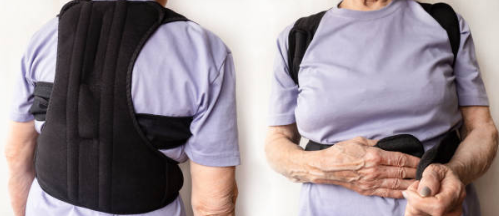
Why does “elastic design” better meet the needs of the human body?
Our bodies are never straight lines, but rather fluid and ever-changing structures.
If a brace is too rigid, it’s actually working against the body.
The advantage of elastic design is that it respects the dynamic structure of the body.
Automatically adjusts the support strength.
When you sit down, bend over, or turn around. When you stand up straight, it automatically rebounds to provide support.
It’s like an auxiliary system that “understands your body language.”
More comfortable to wear for a long time
Traditional correction belts may feel oppressive after 30 minutes, but the elastic structure can keep blood circulation smooth,
so there will be no obvious discomfort even if worn for 4 to 6 hours a day.
Help muscles “re-engage” in posture management
Flexible support prevents muscle groups from being completely “lazy”, thus avoiding the “muscle dependence” caused by traditional correction belts.
Elasticity is not just about comfort, it’s also the key to correction
The seemingly soft elastic structure is actually an “intelligent control system” that automatically distributes tension according to changes in body posture , achieving “dynamic support . “
For example, when you hunch your back, the elastic band on your back will be stretched, creating a “rebound force” to remind you to stand up straight.
When your posture is correct, this force will naturally weaken, allowing you to easily maintain your posture.
This “adaptive rebound mechanism” is the real secret to the effectiveness and durability of posture correctors.
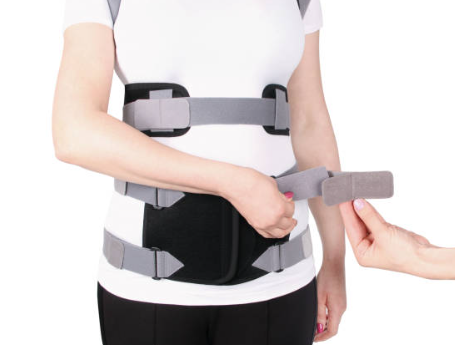
What is the best posture corrector?
Many people ask, “There are so many posture correctors on the market, how do I choose?#8221;
In fact, a “good” brace is not only about its support but also about whether it understands your body rhythm .
The ideal brace should have the following characteristics:
High elastic memory material—can rebound quickly after stretching and is not easy to deform.
Partitioned elastic structure—key parts are supported in place, while other parts are flexible.
Breathable mesh design—especially suitable for long periods of sitting, summer, or exercise.
Lightweight structure—does not cause shoulder and neck burden and can be worn invisibly under clothes.
If you’re looking for a truly balanced balance of support and relaxation,
Try products with an ergonomically designed elastic structure, PU fabric, and a double-rebound back design.
These not only improve your posture but also help you manage the fatigue of prolonged sitting.
For example, the all-day wear posture corrector – unisex crisscross design that uses a combination of breathable mesh fabric + elastic fiber support layer—not only corrects incorrect posture but also does not affect flexibility.
Summary: Support and relaxation can actually be the same thing
“Flexible design” is not just technology but also a gentle philosophy. It reminds us that life should not be forced, but should be flexible, breathable, and have space.
A good posture corrector doesn’t just help you straighten up; it also helps you regain your rhythm and find a relaxed state.
Whether you’re sitting for long periods at the office, studying at a desk, or relaxing after a workout, it can help you find the perfect balance between support and relaxation.
If you are also looking for a good posture corrector , then start trying it now – let your body remember the correct posture while making your life stand up again.